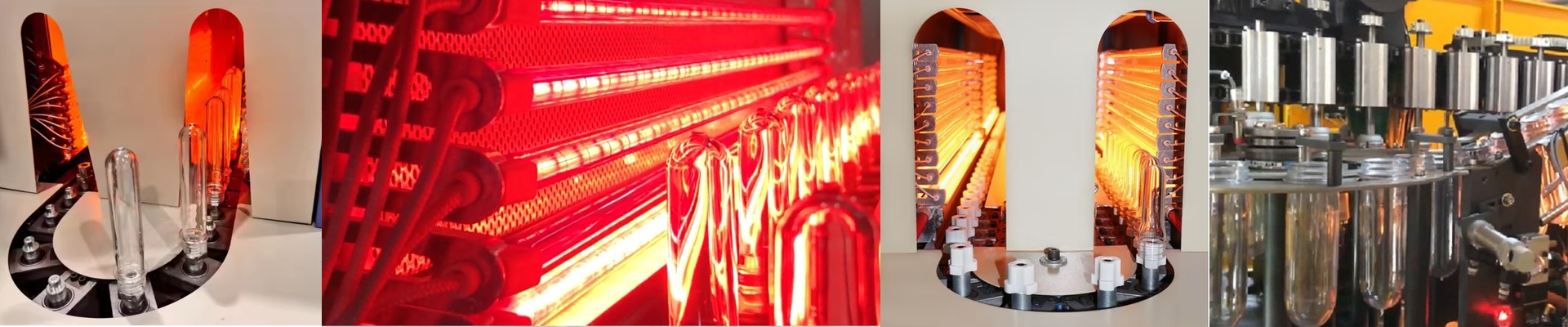
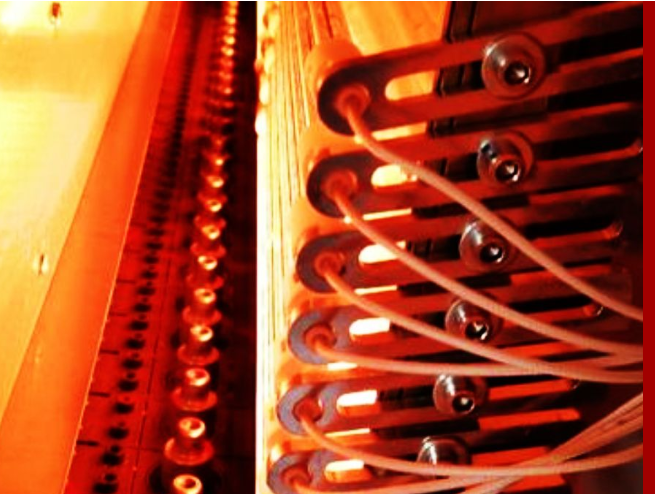
On a Husky stretch blow molder, the heating tunnel is where the whole cycle hangs together. When preforms run uneven, you’re immediately chasing neck finish stability, stretch ratios, and wall distribution. If the IR output drifts or the emitter geometry is off relative to the machine’s focal line, you’re going to see scrap and unplanned stops.
What matters, technically
The Husky preform molding IR radiator is built around short-wave infrared in a quartz envelope, engineered to match the original OEM heating profile. Typical ratings are 2400–3600 W, 220–240 V, with R7s base termination for a direct fit. We hold filament geometry and reflector alignment to tight tolerances so energy density stays consistent across the preform wall. Output holds steady over thousands of hours, with field-reported life of 5,000+ hours and low lumen decay.
Why it fits the Husky tunnel
This radiator is spec’d to match the Husky tunnel geometry. That translates to faster temperature recovery after a jam clears, more repeatable preform surface temperature, and fewer hot/cold bands that mess up the stretch. In practice, you get more consistent bottle weight, less sensitivity to flash, and fewer heater-related alarms. Energy use drops because the emitter heats on demand and the reflector keeps the beam on the preform, not bleeding off onto the frame.
The details that bite you
Installation is straightforward, but the heating window is touchy. Verify alignment to the preform path and make sure voltage and connector match before you start up. Throw in mismatched emitters and you can push the PID loop into oscillation and drift the neck temperature. Keep the reflector clean and watch for quartz clouding — even a thin film scatters output and shifts the heating curve. When you cover those basics, the Husky IR radiator runs the way the OEM spec intended.