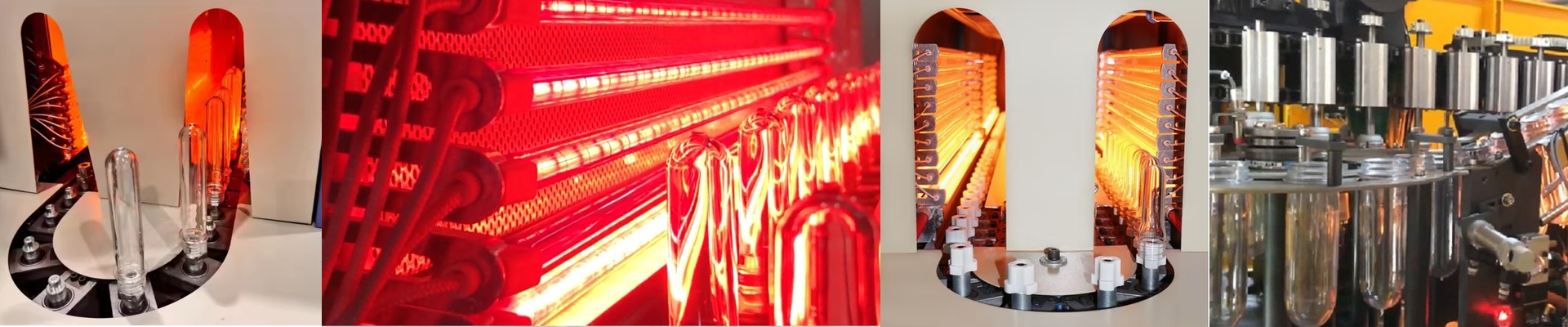
On the Combi blower, the line doesn’t wait for anything—preforms feed in, the heating tunnel comes up to temp, and the timing is locked. Every second of heat is planned. You know the moment an infrared lamp starts drifting: a cold spot across a cavity, uneven wall thickness, and then the rejects climb. You don’t need “better.” You need a lamp that matches the machine, the process window, and the cycle.
What actually matters: infrared lamp specs that earn their keep
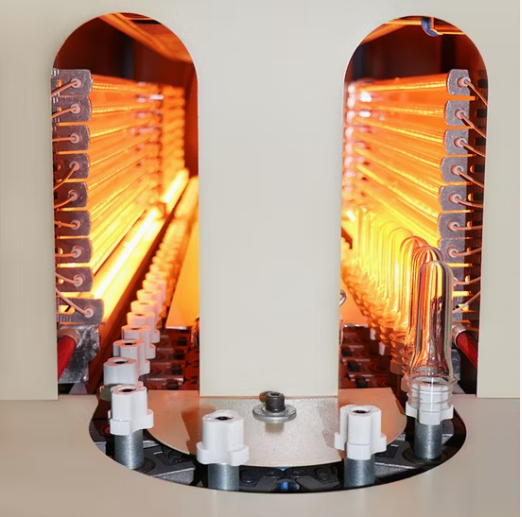
We build the Sidel Combi blower infrared lamp spare around the realities of stretch blow molding—fast response, stable output, and repeatable positioning inside the heating tunnel. **Emitter technology and wavelength.**With PET preform heating, the goal is controllable surface heat without cooking the core. Short-wave quartz halogen infrared emitters give you fast heat-up and fast cool-down, which matters because the machine cycles and the lamps switch on/off in sync with the recipe. The output is tuned to a peak in the near-infrared band, so energy is absorbed at the preform surface, letting you hit the right temperature profile quickly. **Power density and voltage.**Combi heating zones are engineered around specific power per lamp. We match the wattage to the OEM intent—typically 1,000 W to 1,500 W per lamp, depending on the Combi model and where the zone sits (entry, mid, exit). Voltage is matched to the lamp circuit—often 230 V—so current draw stays predictable and the control system sees stable behavior. **Physical fit: length, diameter, and connector.**The lamp has to sit in the reflector and socket exactly as designed. We hold the overall length and arc length to match the Combi reflector envelope, and keep the tube diameter consistent so the lamp seats cleanly. The connector is R7s, the standard for these high-temperature quartz halogen lamps. If the connector doesn’t mate right, the lamp won’t align in the reflector—and you lose focus and temperature uniformity. **Start-up behavior and stability.**On a blow molder, the lamp has to come up fast at shift start and then hold steady while preforms fly through. We specify cold-start capability that matches the Combi’s demand, with stable resistance across repeated cycles. In practice, that means repeatable heat output from the first preform to the last—no slow drift that forces you to chase temperature mid-run. **End-of-life behavior.**When a lamp ages, you want predictable degradation, not a surprise failure. The filament and quartz geometry are designed for a gradual output trend, so you can plan replacement during a scheduled stop instead of reacting to a line shutdown.
Why it works on a Sidel Combi: compatibility, process gains, and cost control
The Combi heating tunnel is a matched system—reflectors, lamp position, airflow, and control logic all work together. Drop in a lamp that isn’t matched, and you don’t just lose efficiency; you lose control of preform temperature. **A true 1:1 fit to the Combi heating system.**We match the lamp to the Combi’s reflector geometry and socket interface. That matters because the reflector is designed to focus infrared energy onto the preform path. If the lamp is off by a few millimeters or the arc length is wrong, the beam pattern shifts and heating becomes uneven across preforms. With the correct lamp, you restore the intended heat distribution and keep the heating profile consistent. **Temperature repeatability that shows up as fewer rejects.**The biggest red flag with a mismatched lamp is variation—some cavities run cooler, some preforms come up short, and the machine starts chasing offsets. A properly matched infrared lamp brings back the intended temperature curve, which means more consistent stretch behavior and fewer off-spec bottles. **Faster recovery after changeover.**When you switch formats, the heating zones have to re-stabilize quickly. A lamp that matches the Combi’s thermal response helps the tunnel regain setpoint faster, cutting scrap and getting the line back to full speed sooner. **Predictable energy use.**Infrared heating is efficient when the energy lands where it’s needed. A lamp that’s aligned, focused, and running at the intended wattage keeps the heating process tight. You avoid wasted output bleeding into the machine frame and surroundings, which keeps energy per bottle more stable. **Less downtime risk.**Unplanned lamp failures force a shutdown—usually at the worst time. We build the spare to meet expected service life in a Combi environment, and we design it to fail predictably. That means fewer emergency stops and more scheduled maintenance.
What you need to know: installation, compatibility, and real-world constraints
A good lamp still has to be installed and maintained correctly. Here’s what we see in the field. **Confirm the exact reference.**The Sidel Combi line spans multiple generations and heating configurations. Before ordering, match the lamp to the machine serial number, the heating zone layout, and the existing lamp marking. If wattage, voltage, length, and connector don’t match what’s installed, you’ll throw off the heating balance of the tunnel. **Handle the quartz properly.**Don’t touch the quartz tube with bare hands. Skin oils create hot spots that shorten life and can cause premature failure. Use a clean, lint-free cloth or the original packaging, and make sure the lamp seats squarely in the reflector and socket. **Reflector condition matters.**A lamp can be perfect, but a dirty or oxidized reflector will scatter energy and create uneven heating. When you replace the lamp, inspect the reflector surface—clean it, or replace it if it’s pitted or discolored. Otherwise, you’re trying to compensate for a reflector problem with a new lamp. **Thermal stress and cooling.**These lamps run hot, and the heating tunnel is a hot environment. Keep airflow unobstructed and make sure the lamp isn’t forced into a position that blocks cooling paths. Excessive heat buildup around the lamp base will cut service life. **One trade-off: brittleness.**Quartz halogen infrared lamps perform well, but they’re brittle. Drop one, and it’s done. Carry spares in protective packaging, and store them in a dry, stable environment. This isn’t a design flaw—it’s physics. Treat the lamp like the precision component it is, and it will deliver predictable runs. If you’re running a Sidel Combi blower and you need an infrared lamp spare that behaves like the original, spec it to the machine, the zone, and the process. Match wattage, voltage, length, and the R7s interface. Restore the heating profile, and you restore stable output, predictable energy use, and fewer stops.